

01
Stopping silent leaks
Subscriptions, fees, impulse buys. First, keep hold of the money slipping through the cracks.
Part I is the foundations
Budget, buffer, working on your own craft and first steps in investing.
Part II is the workshop
Lessons from speculators, value investors and manipulators — and your own process.
“Today's workshop”
At the end of every chapter. Do at least one point before you move on.
“Dirk's Pallet Test”
Appears wherever you make a risky decision. Treat it like a checklist before lifting a load.
The idea behind the book
Lessons gathered between warehouse shifts, living abroad and early market mistakes. No promises of quick riches — just a method that works on an ordinary Tuesday.
Subscriptions, fees, impulse buys. First, keep hold of the money slipping through the cracks.
A budget with 40 categories loses out to three pots you actually keep track of after a ten-hour shift.
Limited downside, open upside. Dirk’s four questions before every decision — just as before lifting a pallet.
The load-bearing rack of your finances. Only once it stands firm can your money get to work in the market.
Free e-book · Honesty Loop
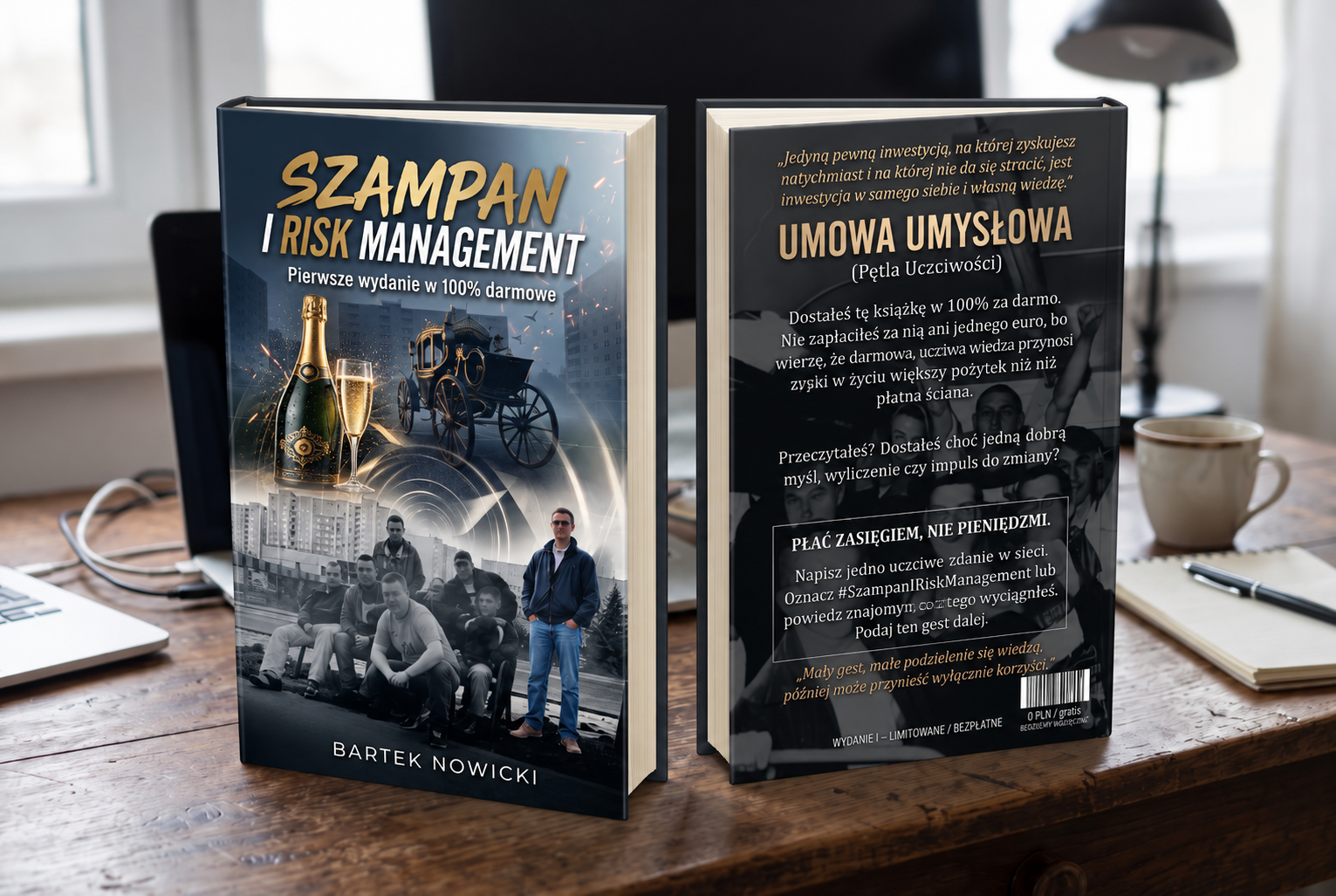
“The only sure investment that pays off immediately and cannot lose is an investment in yourself and your own knowledge.”
You pay nothing. Free, honest knowledge does more good in life than a paywall.
Write one honest sentence online, use #SzampanIRiskManagement or tell a friend what you took from it.
A small gesture, a little knowledge shared, can go a long way later on.
Expanded print edition
The print edition contains the same text as the e-book, plus practical tools you can fill in with a pencil. No artificial barriers — the e-book remains complete.
The three-pot budget, your peace-of-mind number and a position-sizing calculator.
Dirk's Pallet Test as a card to fill in before every decision.
Manipulation red flags, a weekly review and the CryptoPark rules.
Pages to record what, why, how much I can lose and when I exit.
Alongside the chapters, links to podcast episodes and videos.
Contents
Choose any chapter to open it straight away in the reader.
 1
Chapter 1
The Babylonian principle of “pay yourself first”, applied to a Belgian pay packet. How to find the quiet leaks and hold on to that first 10%.
Read chapter 2
Chapter 2
Three baskets instead of spreadsheets with 40 categories. Why Benny abandoned his spreadsheet after two weeks, and how to build a budget that lasts a year.
Read chapter 3
Chapter 3
Inflation as a quiet thief, a buffer before investing, and the difference between investing and gambling. A first encounter with ETFs.
Read chapter 4
Chapter 4
Why you can be wrong on most decisions and still make money. Risk versus reward, position sizing and the first full application of Dirk's Pallet Test.
Read chapter 5
Chapter 5
How to use artificial intelligence to summarise reports, build checklists and find holes in your own reasoning — and what never to hand over to it.
Read chapter 6
Chapter 6
The best investment at the start of your journey is often yourself. Qualifications, language and skills that pay for themselves faster than any share.
Read chapter 7
Chapter 7
Your peace-of-mind number, your freedom number and the first outline of your own direction. The end of Part I: the foundations are ready, and it's time for the workshop.
Read chapter 8
Chapter 8
Jesse Livermore made and lost several fortunes. What he tells us about cutting losses, letting profits run and the mathematics of drawdowns.
Read chapter 9
Chapter 9
Mr Market, intrinsic value and the margin of safety. How the father of value investing helps you buy with greater peace of mind.
Read chapter 10
Chapter 10
Pump and dump, time pressure and sales scripts. How financial manipulation works and how to recognise it today — on Telegram, TikTok and in ‘exclusive groups’.
Read chapter 11
Chapter 11
Hard money, time preference and a critical look at Ammous's arguments. How to build CryptoPark — a separate area of your portfolio with its own rules.
Read chapter 12
Chapter 12
All the lessons in one system: portfolio layers, a decision journal, rebalancing and your own ‘investor's charter’. Time for champagne — well earned.
Read chapterA method from the warehouse
Dirk, a foreman in Hoboken, would not let anyone lift a pallet until the operator had answered four questions. The same checklist works before any investment decision.
1. Weight
Exactly how much can I lose?
Risk ≤ 2% of capital, no leverage.
2. Wrapping
Do I understand what I’m buying?
You can explain it in two sentences.
3. Route
Have I written down my exit point?
Set the stop before entering.
4. Racking
Does the reward outweigh the risk?
Reward-to-risk ratio ≥ 2:1.
Calculator
Potential loss
100.00 €
Number of units
20
Position value
2,000.00 €
Reward : risk
3.0 : 1
Do not lift
Two or more checks failed. Dirk would send this pallet back for repacking.
An educational tool for long positions. Not investment advice.
Podcast and video
Two series on one channel. Listen on the bus, watch on your break.
Knowledge base
Every term follows the same pattern: what it is, how it works, a real-life example and where the risk lies.

Antwerp · Hoboken
“My first lessons in risk came not from the stock exchange, but from loading bay four.”

About the author
I arrived in Belgium with one suitcase and no financial plan. For years I did manual work in warehouses in Antwerp and Hoboken — night shifts, pallets, forklifts and a canteen with vending-machine coffee.
There, between shifts, I began learning about money: from the first coin saved, through costly market mistakes, to an investment process of my own. This book records that journey — and the people who taught me along the way.
I am not a financial adviser. I am someone who started from nothing and wants to make your journey shorter.
Bart Nowicki